
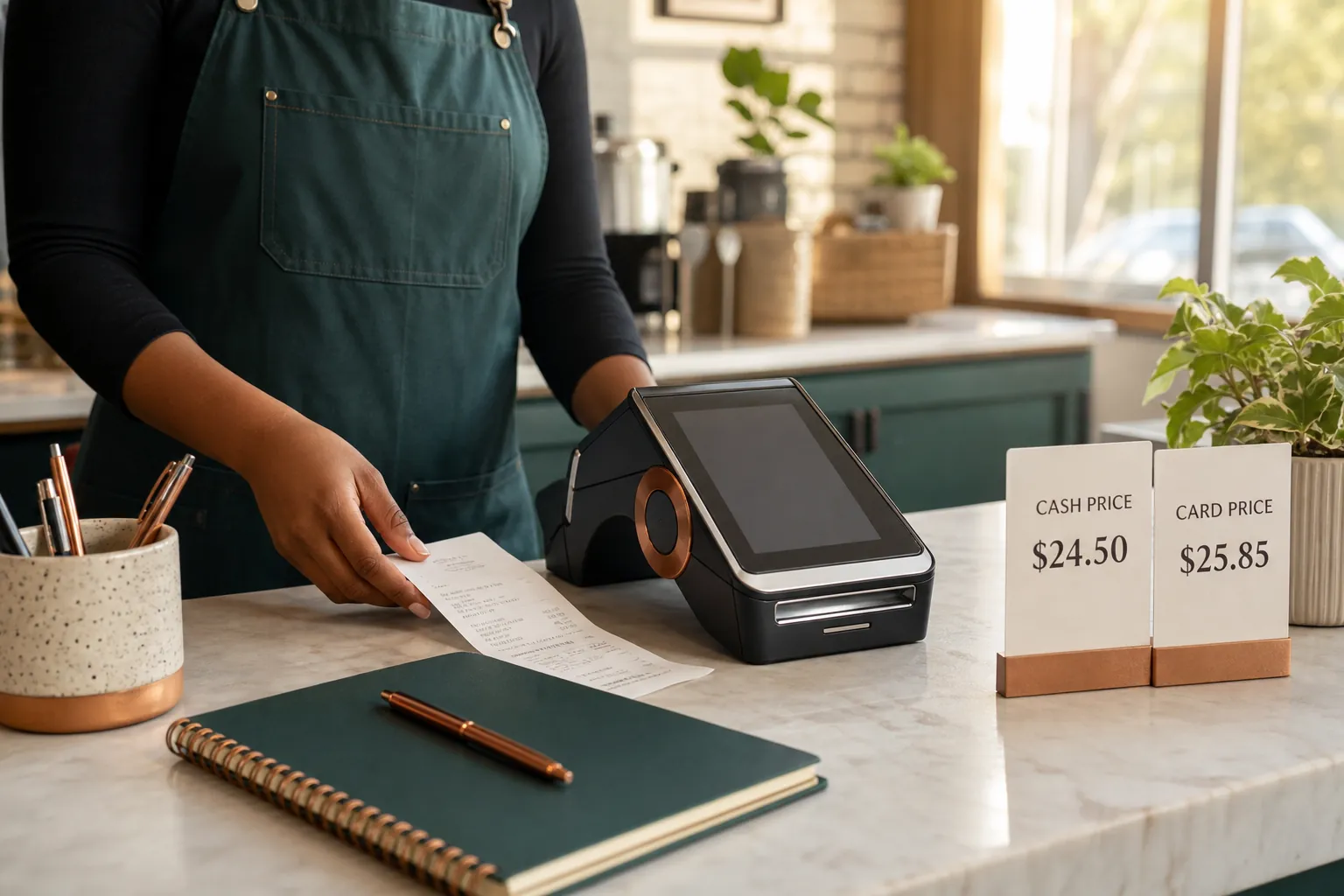
Dual pricing is a way for a business to show customers two prices for the same purchase: one price for paying by card and a lower price for paying by cash. The idea is simple. Card payments cost the merchant money. Cash does not carry the same processing cost. Instead of hiding that cost inside the business or surprising customers at checkout, dual pricing makes the difference visible before the customer pays.
For many owners, the question is not whether card payments are useful. They clearly are. Customers expect to tap, swipe, insert, pay online, and move on. The real question is how to offer that convenience without letting processing costs quietly eat into already-thin margins. Dual pricing is one answer, but it has to be set up with care because pricing, signage, receipts, staff training, and customer trust all matter.
This guide explains what dual pricing means in everyday business language, how it differs from surcharges and cash discount programs, where it can make sense, and what to review before changing how customers pay.
How dual pricing works at checkout
In a clean dual-pricing setup, the customer sees the price difference before payment. A product, menu, invoice, or point-of-sale screen may show a standard card price and a lower cash price. If the customer pays by card, they pay the card price. If they pay by cash, they receive the cash price.
A simple example is a cafe item listed as $25.85 by card or $24.50 by cash. The card-paying customer is not surprised by a fee after choosing their payment method. The cash-paying customer sees a clear savings option. That difference is the reason dual pricing can feel more transparent than a last-second fee line.
In practice, the system only works well when the payment equipment supports it. The terminal, receipt, posted signs, and staff explanation should all tell the same story. If the shelf tag says one thing, the terminal says another, and the receipt labels the difference in a confusing way, customers will assume the business is playing games with the price. That is exactly what dual pricing is supposed to avoid.
Dual pricing vs. surcharges vs. cash discounts
The words get mixed together because all three approaches deal with card-processing costs. They are not the same from a customer-experience point of view.
A credit card surcharge adds a separate fee when a customer pays with a credit card. Visa says U.S. merchants that surcharge must limit surcharges to credit cards, not debit or prepaid cards, and must disclose the surcharge at the point of entry, point of sale, and on receipts. Visa also says the surcharge cannot exceed the merchant discount rate for the applicable credit card or 3%, whichever is lower. You can read Visa's merchant guidance on its U.S. merchant surcharge Q&A.
Mastercard describes surcharge disclosure requirements as well, including disclosure at the point of interaction and showing the surcharge amount on the transaction receipt. Its merchant rules also tie the surcharge level to the merchant's cost of accepting the card, subject to a cap. Mastercard explains those requirements in its merchant surcharge rules.
A cash discount works from the other direction. The posted price is usually the card price, and a customer who pays cash receives a discount. Some businesses call this dual pricing when both prices are displayed clearly. The important practical difference is whether the customer feels they are being rewarded for cash or penalized for using a card.
That perception matters. Many customers dislike surprise fees more than they dislike a higher posted price. If the card price is presented upfront and the cash price is framed as a lower option, the conversation is easier for staff and less frustrating for the person paying.
Why business owners consider dual pricing
Payment processing is one of those costs that can feel small on each transaction and painful at the end of the month. A few cents and a few percentage points do not sound dramatic until the business adds up every card sale, every reward card, every keyed transaction, every online invoice, and every monthly statement line.
Dual pricing gives owners a way to protect margin without going cash-only. That matters because going cash-only can reduce convenience, slow service, create security headaches, and push away customers who expect to pay electronically. The goal is not to punish card users. The goal is to make payment costs visible enough that the business can price responsibly.
It can also create a cleaner internal conversation. Instead of treating processing fees as a mysterious bill from the processor, the owner can connect pricing, customer payment behavior, and margin in one place. That makes it easier to decide whether the business should update prices, negotiate processing, change equipment, adjust checkout signage, or leave the model alone.
Where dual pricing may fit best
Dual pricing tends to fit businesses where customers understand price differences and where the checkout experience gives enough space to explain them. Restaurants, cafes, convenience stores, salons, repair shops, local retail, and service businesses with in-person payments often consider it because customers already see posted pricing and pay at a counter, table, register, or invoice.
It can also make sense when ticket sizes are large enough for processing fees to matter, but not so sensitive that a small price difference damages trust. A business with frequent low-margin transactions may feel processing fees more sharply than a business with fewer, higher-margin purchases. A service business that invoices clients may have an easier time explaining payment choices in writing than a busy counter-service business during a lunch rush.
The wrong fit is just as important. If customers already complain about price changes, if staff are not trained, if the point-of-sale system cannot display both prices cleanly, or if the owner is unsure which rules apply, dual pricing can create more friction than it solves.
Customer trust is the real test
A pricing model that saves money but damages trust is not a win. Customers do not need a lecture about interchange, assessments, processor markup, and card-brand rules. They need to know what they will pay, why the price looks different, and whether they have a fair choice.
The best explanation is short. For example: "The card price is the standard price. We offer a lower cash price when you pay with cash." That is enough for most customers. If a business needs three paragraphs at the counter to justify the model, the setup is probably too confusing.
Signage should be visible before payment, not hidden by the terminal. Receipts should match what the customer saw. Staff should use the same words every time. The more consistent the experience feels, the less likely customers are to treat the price difference as a surprise fee.
Legal and card-network details to review
Dual pricing is often discussed as a simpler alternative to surcharging, but "simpler" does not mean "ignore the rules." State law, card-network rules, debit-card treatment, advertised prices, receipt language, and point-of-sale behavior can all affect how a program should be configured.
State guidance can vary. For example, the California Department of Justice says California law allows merchants to give customers discounts for paying by cash, check, or debit card as long as the discount is offered to all customers, while also explaining the state's history around credit card surcharge restrictions. That consumer guidance is available on the California DOJ credit-card surcharges page.
A business should also confirm how its processor and equipment label the transaction. Some systems use terms like cash discount, non-cash adjustment, service fee, convenience fee, or surcharge. Those labels are not interchangeable. The label should match the actual pricing method and the rules that apply to it.
If the business operates in multiple states, sells online, takes debit cards, or works in a regulated industry, it should be especially careful. When in doubt, ask the processor for written program details and get legal or compliance guidance before rolling it out.
A practical checklist before changing your pricing
Start with the numbers. Look at total card volume, average ticket size, monthly processing costs, card mix, debit-card share, keyed transactions, online payments, chargebacks, and current equipment costs. The point is to understand whether the savings are meaningful enough to justify a change.
Then look at the customer experience. Can customers see the price difference before they pay? Can staff explain it without sounding defensive? Will the receipt make sense? Does the business have regulars who may react strongly to a change? Is the lower cash price easy to calculate and display?
Finally, look at the system. The payment terminal and point-of-sale software should support the model cleanly. Manual workarounds create mistakes, and mistakes create customer complaints. If the equipment cannot display pricing transparently, it may be better to update the payment setup before changing the pricing model.
Common mistakes that make dual pricing harder
The first mistake is treating dual pricing as only a terminal setting. It is really a customer communication decision. The software can calculate the right amount, but it cannot rescue a confusing counter sign, a surprised cashier, or a receipt that uses language customers do not recognize.
The second mistake is choosing a percentage before checking the current statement. Some owners hear a standard number and assume it fits their business. That can be wrong. The right discussion starts with the real cost of acceptance, the business's actual payment mix, and the rules attached to the cards customers use most often.
The third mistake is rolling it out without a short staff script. Employees do not need to become payment experts, but they do need a calm sentence that explains the difference. If every employee describes the program differently, customers will hear uncertainty. Uncertainty at checkout feels expensive even when the math is correct.
The fourth mistake is using dual pricing to avoid reviewing the broader payment setup. If the business has outdated terminals, weak reporting, slow deposits, poor support, or unnecessary monthly charges, dual pricing may only solve one piece of the problem. Owners should still review the full merchant-services relationship.
A sensible rollout plan
A good rollout starts quietly, before customers see anything. Confirm the model with the processor. Review state and card-network requirements. Test the terminal. Print sample receipts. Check that the card price, cash price, and discount language match across the point-of-sale screen, customer display, printed receipt, invoice, and any posted signs.
Next, prepare the team. Give staff the exact words to use and the exact person to call if a customer has a question they cannot answer. The goal is consistency, not improvisation. A simple explanation usually works better than a defensive one.
Then watch the first few weeks closely. Track complaints, cash usage, card usage, average tickets, and whether checkout slows down. If customers are confused, the answer may be clearer signage or better receipt language, not abandoning the idea immediately. If customers are frustrated, the answer may be that the model does not fit that audience.
The strongest programs are boring in the best way: clear prices, clean receipts, trained staff, and no awkward surprises. If the rollout creates drama at the counter, something needs to be simplified.
How JustOneCall.tech helps
JustOneCall.tech helps business owners sort through practical service paths, including payment processing through CardConnect Baltimore. For owners comparing dual pricing, merchant services, terminals, gift cards, wireless processing, or compliant checkout options, the useful first step is not a generic form. It is a focused conversation about how the business actually gets paid.
The team can help you look at the payment lane alongside the rest of the operation: customer experience, monthly costs, cash flow, and the tools needed to keep checkout moving. If dual pricing is worth exploring, the next conversation should be specific to your business, not a canned pitch.
Want to review your payment setup?
Start with one call and a clear look at how your customers pay today.
Frequently asked questions
Is dual pricing the same as a credit card surcharge?
No. A surcharge adds a separate fee when a customer pays by credit card. Dual pricing usually presents a standard card price and a lower cash price, so the customer sees the choice before paying.
Can every small business use dual pricing?
Not automatically. The fit depends on customer habits, transaction size, checkout setup, signage, receipt wording, state rules, and card-network requirements. A business should review the model before turning it on.
Will dual pricing upset customers?
It can if the pricing feels hidden or punitive. It usually works better when the card price is clear, the cash price is framed as a savings option, and staff can explain it calmly in one sentence.
What should a business review before changing payment pricing?
Review current processing costs, average ticket size, payment mix, customer expectations, signage, receipts, staff training, and whether the payment system can show the right price at the right time.