
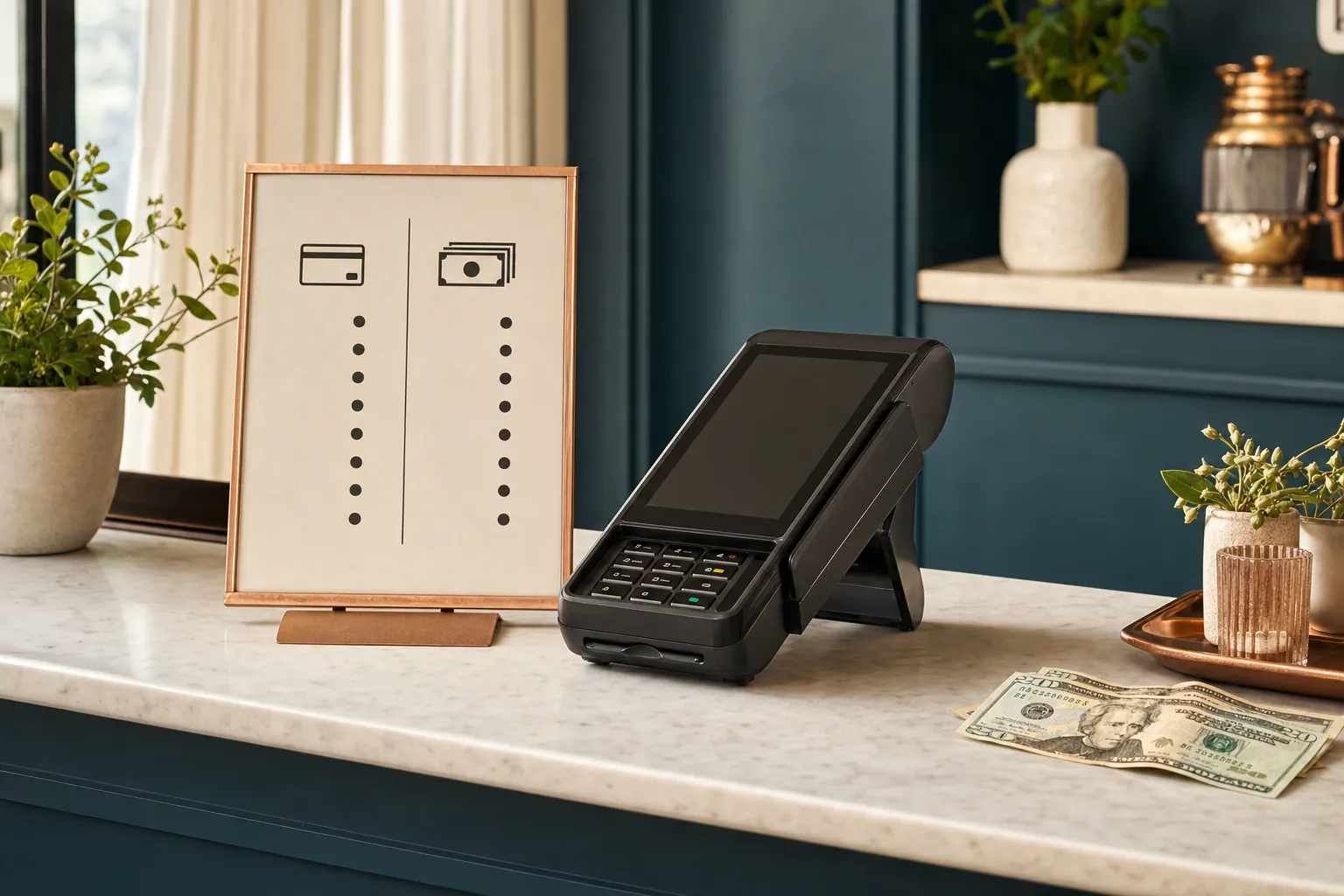
Cash discount versus surcharge is not a word game. It is a pricing decision that shows up at the counter, on the receipt, in online checkout, and in the way customers talk about a business after they leave. Both approaches are often presented as ways to deal with card-processing costs. The useful question for an owner is more practical: which option, if either, fits the way your customers pay and the way your business needs to operate?
A cash discount gives a customer a lower price for paying with cash. A surcharge adds an amount when a customer pays by credit card. That sounds simple, but the details matter. The listed price, the signs, the terminal, the receipt language, debit-card treatment, staff explanation, and program rules all need to line up. A business that gets those pieces wrong can create confusion even when the math looked sensible on a processing statement.
This guide compares the two models in plain language. It is not legal advice or a substitute for a processor or attorney reviewing a specific program. It is a better starting point than choosing a label first and trying to make the checkout experience catch up later.
Start with the plain-English difference
With a cash discount, the customer sees a standard price and receives a lower price for using cash. For example, a service might be listed at $100, while a customer who pays cash receives a $97 price. The customer experiences that difference as a discount or savings option.
With a surcharge, the business begins with an advertised or normal price and adds an amount when the customer chooses a credit card. For example, a $100 purchase could become $103 for a credit-card payment when the applicable program and rules allow it. Visa describes a surcharge as an amount added to the advertised or normal price for a Visa-card transaction on its consumer support page.
The direction of the price is the easiest way to remember it. Cash discount: the customer pays less with cash. Surcharge: the customer pays more with a credit card. The two can feel similar in a spreadsheet because both change the amount a card-paying customer pays. At the counter, though, they can feel very different.
Why the distinction matters to customers
Customers tend to care less about payment-industry terminology than about surprise. If a menu, shelf tag, invoice, or online price appears to promise one amount and the final amount changes only after a card is chosen, the customer may feel nickeled-and-dimed. That reaction can happen even if the business has a valid reason for the fee.
A cash discount often feels easier to explain because the customer can see a lower cash option. A surcharge can feel direct when the business needs the advertised price to remain its base price and wants the added credit-card amount shown separately. Neither approach is automatically friendlier. Clear prices and a consistent explanation are what make the difference.
This is especially important for businesses with regulars. A salon, restaurant, repair shop, local retailer, or service company may save money on processing but lose goodwill if customers discover a new price rule only at the moment they are ready to pay. Before a rollout, ask a blunt question: would a loyal customer understand the final price without a debate?
Cash discount: where it can make sense
A cash discount can be worth considering when a business still accepts cards but wants to offer a visible incentive for customers who pay cash. It may be a better fit for in-person businesses where prices are already posted at a counter, on a menu, in a service estimate, or on a simple invoice. Customers have a chance to see the options before choosing how to pay.
The model can also fit businesses where a cash payment is operationally normal. A neighborhood store with a register, a restaurant that regularly handles cash, or a repair business that collects payment in person may have a more natural setting for a cash option than a business that mostly bills online. It does not mean every cash-heavy business should use it. Handling cash has its own costs, including counting, security, deposits, and reconciliation.
Federal consumer-credit rules recognize discount plans for payment methods. The CFPB's official commentary gives examples of a merchant offering different discounts for cash, check, and a particular credit card, explaining that these discounts are not finance charges under that regulation. See the CFPB's Regulation Z commentary for the underlying rule language. That does not settle every state, processor, or card-network question, but it shows why a genuine discount is treated differently from an added fee.
The risk is calling something a cash discount while the checkout experience tells a different story. If the price shown everywhere is the cash price and a card user sees an extra line only at payment, customers may reasonably experience it as a surcharge. Labels do not clean up a confusing price presentation.
Credit card surcharge: where it can make sense
A credit-card surcharge can make sense when a business needs to keep a base price visible and add the credit-card amount separately, with clear disclosures. It is most often considered by businesses with high card volume, larger ticket sizes, or margins that are materially affected by processing costs. The decision should begin with actual merchant statements, not a generic percentage from a sales pitch.
A surcharge program has to be more precise because the permitted treatment can depend on the card type, the surcharge amount, the disclosure, the payment channel, and the rules of the card networks and acquirer. Visa's U.S. merchant surcharge guidance says its rules allow merchants to offer an alternative-payment discount, while surcharges have separate requirements. Its merchant surcharge Q&A explains the distinction and notes disclosure requirements for surcharging.
Mastercard similarly explains that U.S. merchant surcharges are limited in relation to the merchant's cost of accepting Mastercard credit and subject to a maximum cap. Its current merchant surcharge rules also describe brand-level and product-level approaches. These rules are not an invitation to pick a number and turn it on. They are a reason to confirm the exact setup with the processor that will run the transactions.
The biggest operational trap is assuming a surcharge applies to every card payment. Credit, debit, prepaid, in-person, online, and card-not-present transactions may not be treated the same way. The business needs a payment system that can identify the payment type and apply the program correctly without asking staff to improvise.
Do not use the same checklist for both options
A cash discount program and a surcharge program may both be described as “passing on fees,” but the implementation questions are not interchangeable. A cash discount discussion should focus on the standard price, how the lower cash price is displayed, whether cash actually makes sense for the operation, and whether the business can keep signs and receipts consistent.
A surcharge discussion should start with the processor's specific program, eligible card types, disclosure requirements, receipt language, amount limits, and notification or registration requirements that may apply. It should also confirm how the business will handle online checkout, invoices, recurring payments, refunds, tips, split tenders, and payments where the customer never sees a counter sign.
In either case, the owner should review the full payment picture. The site's payment-processing statistics show why card acceptance remains a major part of how U.S. customers pay. That does not make every processing-cost program a fit. It means a business should weigh customer convenience, operational cost, and margin together rather than treating card acceptance as a single fee line.
A side-by-side decision framework
Consider a cash discount first when the business can clearly display a standard price and a lower cash price, customers commonly pay in person, and cash handling is already a normal part of the day. The model is often easier to discuss in a physical location where the customer can see the choice before payment.
Consider a surcharge only when the processor confirms that it supports the model for the business's specific payment mix and channels. The business must be comfortable with credit-card disclosures, receipt details, and the possibility that some customers will view the additional amount as a fee rather than a choice.
Consider neither when the operation is not ready. If the point-of-sale system cannot show prices cleanly, the staff does not have a shared explanation, the business uses several payment channels that will be hard to keep consistent, or customer trust is already fragile, changing payment pricing can cause more trouble than it saves. Sometimes the better first move is reviewing the merchant account, equipment, and statement for unnecessary cost or poor service.
Match the model to the way your business gets paid
A counter-service business has a different decision from a company that bills by invoice. A cafe, salon, repair counter, or small retailer can usually make a price choice visible before the customer reaches the terminal. That gives a cash discount more room to be understood, provided the signs, menu, and customer display agree. It also gives a surcharge program a place for required disclosure, but only if the business has confirmed the exact requirements for its program.
A professional-service firm, contractor, or business-to-business company may collect payment through estimates, emailed invoices, payment links, or recurring billing. In that environment, the price information needs to be clear before a customer enters card details, not just on a front counter sign. A model that looks clean in a storefront can become confusing when it moves to an online invoice or a phone payment. The more payment channels a company uses, the more carefully the program needs to be mapped.
Restaurants and hospitality businesses deserve extra care because tips, split checks, tabs, delivery orders, and third-party ordering can complicate the final amount. A repair or home-service business may need to consider deposits, change orders, partial payments, and customers who authorize a card before the final invoice is known. A retailer may need to think through returns, exchanges, gift cards, and a mix of debit and credit transactions. The payment flow matters as much as the posted percentage.
Customer expectations matter, too. In a business where cash use is still common and prices are routinely displayed, a cash option may feel familiar. In a business where customers overwhelmingly tap a phone or card, a program that nudges people toward cash may not change payment behavior enough to justify the complexity. In either case, the owner should decide based on real transaction history rather than assumptions about what customers will do.
Location and audience can change the answer as well. A business serving commuters, visitors, or younger customers may see little appetite for carrying cash. A business with repeat local customers may have more room to explain a change thoughtfully, but that goodwill should not be taken for granted. Review the payment mix by location, season, and sales channel when possible. The pattern in a busy Saturday storefront may not match the pattern in an emailed invoice or a weekday service call.
There is no prize for moving every payment to one model. Some owners may decide the best answer is accepting the cost of cards as part of the offer, then improving pricing or negotiating the merchant-services relationship elsewhere. A payment program should make the business easier to run, not create a second job explaining checkout to confused customers.
The best choice is the one customers can understand quickly and the business can operate consistently every day.
Run the math before choosing the language
Owners should not decide between cash discount and surcharge based on a headline rate. Pull the last several processing statements and look at total card volume, effective rate, debit share, credit share, average ticket, keyed transactions, online payments, recurring billing, chargebacks, equipment fees, monthly minimums, and other line items. The answer is not just “what percentage do we pay?” It is “what costs are we actually trying to solve?”
Then estimate the customer effect. A three-dollar difference on a one-hundred-dollar invoice may be manageable in one business and frustrating in another. A small percentage on frequent low-dollar purchases may produce more questions than savings. A cash option may be practical for a counter business but irrelevant for a company that collects most payments through emailed invoices.
Finally, test the operational edge cases. What happens when a customer pays partly by cash and partly by card? How are tips handled? What does a refund look like? Does the invoice show the right amount before the customer enters card details? Can a staff member explain the price in one sentence? A pricing model that works only in the ideal transaction is not ready for a real business day.
Signs, receipts, and staff language are part of the product
A program can be technically configured and still be poorly delivered. Customers judge the experience by what they see first. The sign, menu, shelf tag, quote, website, invoice, terminal, and receipt need to tell the same story. If the card price appears in one place, the cash price appears in another, and the receipt uses a third label, staff will spend the day trying to translate the policy.
Keep the staff explanation short. For a cash discount, a simple version might be: “The listed price is the card price, and we offer a lower price for cash.” For a surcharge, the language needs to match the approved program and should not be improvised. The point is not to make every employee a payments expert. It is to avoid surprise and contradiction.
A small pilot can be useful when the business has the ability to test carefully. Review customer questions, payment mix, average ticket, reversals, staff feedback, and checkout speed. If the first week produces confusion, revisit the signs and system before treating the program as a success or failure.
Common mistakes to avoid
The first mistake is choosing the most attractive label instead of the real pricing behavior. Calling a card fee a “service adjustment” does not change what the customer sees or what rules may apply. The price presentation has to match the program.
The second is treating debit cards like credit cards. Payment cards can look similar to a customer, but the rules and program treatment may be different. A setup should identify eligible transactions correctly rather than relying on an employee to guess at the counter.
The third is ignoring remote payments. An owner may have perfect counter signage and still need to think through online orders, text-to-pay links, invoices, recurring billing, and virtual terminals. The customer needs to see the right price before completing payment in every channel the business uses.
The fourth is forgetting that card-processing costs are only one part of the relationship. A business with slow deposits, unreliable equipment, unclear reports, weak support, or excess account fees may benefit more from a broader merchant-services review than from a new pricing program alone. The existing guide to dual pricing covers another way owners often approach that decision.
How JustOneCall.tech can help
JustOneCall.tech helps owners begin with the business they actually run: how customers pay, where the payment friction shows up, and whether a payment-program conversation is worth pursuing. That can include card acceptance, terminals, wireless processing, gift cards, online payments, and merchant-services options connected through CardConnect Baltimore.
For an owner comparing cash discount, surcharge, or dual pricing, the right first step is a focused review rather than a generic switch. The dual pricing merchant services page explains the practical payment review path, and the broader solutions overview shows how payment decisions fit alongside the rest of the business.
Want a clearer view of your payment setup?
Start with one call and a practical look at how customers pay today.
Frequently asked questions
Is a cash discount the same as a credit card surcharge?
No. A cash discount lowers the price for a customer who pays with cash. A surcharge adds an amount to the advertised or normal price when a customer uses a credit card. The distinction affects how the price is presented, what customers see, and which rules may apply.
Can a business surcharge debit cards?
A business should not assume it can. Visa and Mastercard surcharge guidance distinguishes credit cards from debit and prepaid cards. The processor, payment equipment, and card-brand rules should be reviewed before a program goes live.
Which is better for customer experience: cash discount or surcharge?
Neither wins automatically. A cash discount can feel like a visible savings option when the pricing is clear. A surcharge can be straightforward when a business needs to show a base price and an added credit-card amount. In either case, surprise is the real problem to avoid.
Do I need to change my payment terminal?
Possibly. The terminal, point-of-sale system, receipts, online checkout, invoices, and signs all need to show the same pricing logic. A payment review should confirm that the current setup can support the chosen model without manual workarounds.
Should I speak to a lawyer before changing card pricing?
A processor can explain its program and equipment requirements, but it does not replace legal advice. Owners with multi-state operations, online sales, regulated services, or uncertainty about local requirements should get appropriate legal or compliance guidance before changing prices.
Related posts
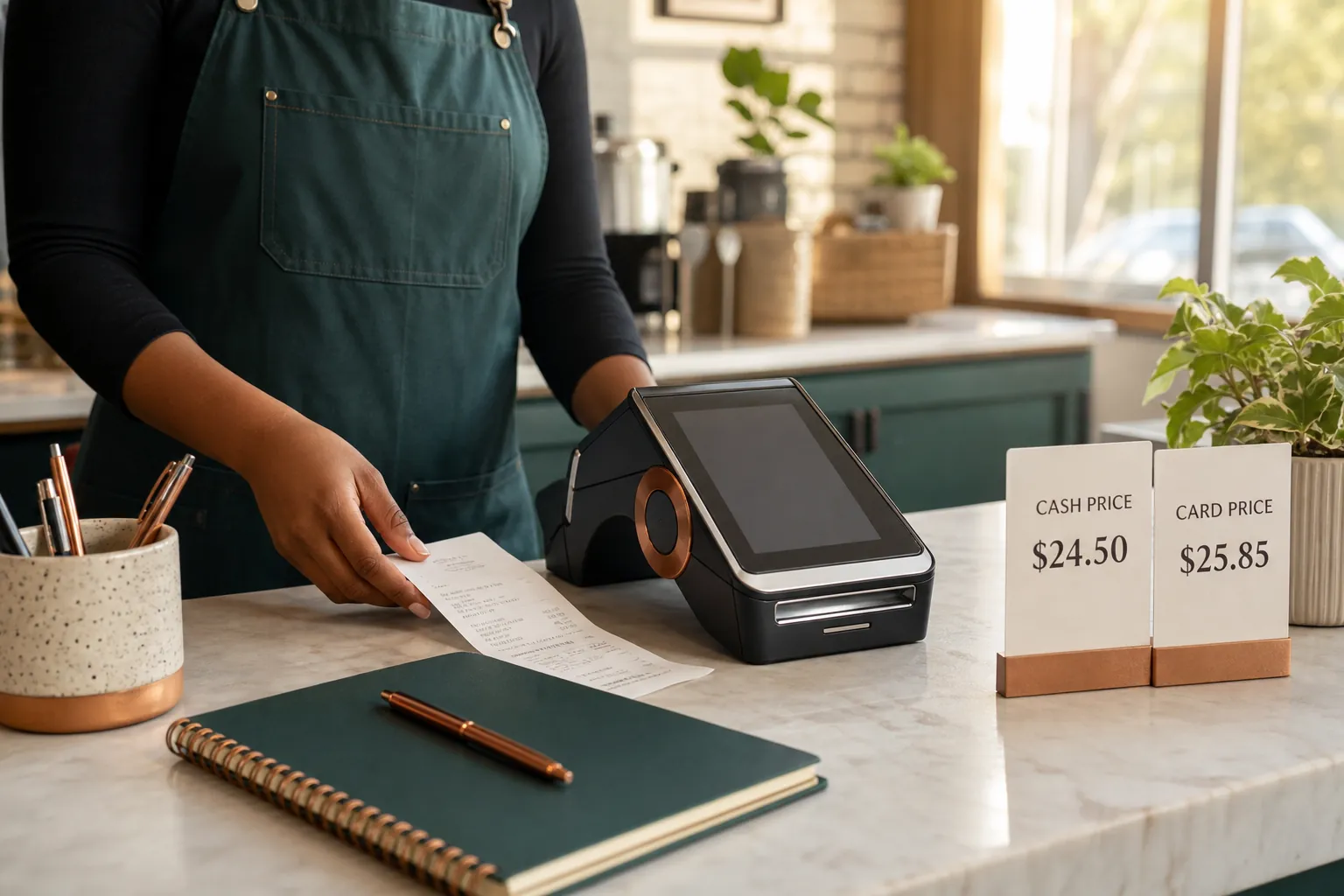
What Is Dual Pricing? A Practical Guide for Owners
See how dual pricing compares with cash discounts and surcharges at a small business checkout.
Read the guide